

Ingredient List and Allergen Declaration
Descending order by weight, and how the United States, the EU and UK, and Australia and New Zealand require allergens to be declared
Descending order by weight
All three regions order the list the same way. 21 CFR 101.4(a)(1) requires ingredients to be listed by common or usual name in descending order of predominance by weight. Article 18(1) of Regulation (EU) No 1169/2011 requires the list, headed by the word "ingredients", to include all ingredients in descending order of weight as recorded at the time of their use in the manufacture of the food. Section 1.2.4—5 of the Australia New Zealand Food Standards Code requires each ingredient in descending order of ingoing weight.
The generator sorts your recipe by the gram weight of each ingredient and prints the list in that order.
Declaring allergens
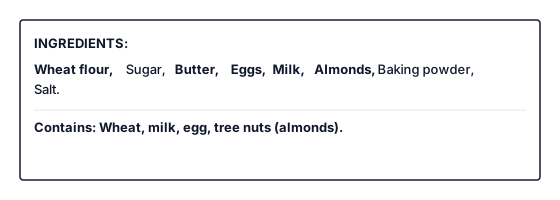
United States: 21 U.S.C. § 321(qq) defines the major food allergens as milk, egg, fish, Crustacean shellfish, tree nuts, wheat, peanuts, soybeans and sesame — sesame from 1 January 2023 under the FASTER Act. Under § 343(w) a packaged food must either print the word "Contains" followed by the food source immediately after or next to the ingredient list, or give the food source in parentheses after the ingredient's name within the list.
European Union and United Kingdom: Annex II of Regulation (EU) No 1169/2011 lists 14 substances or products causing allergies or intolerances — cereals containing gluten, crustaceans, eggs, fish, peanuts, soybeans, milk, nuts, celery, mustard, sesame seeds, sulphur dioxide and sulphites above 10 mg/kg or 10 mg/litre, lupin and molluscs. Article 21 requires their names to be emphasised in the list of ingredients through a typeset that clearly distinguishes them, for example by font, style or background colour; where there is no list of ingredients, the word "contains" followed by the name is used.
Australia and New Zealand: Standard 1.2.3 requires the foods listed in Schedule 9 of the Code to be declared by their required name in the statement of ingredients, printed in bold and in a type size no smaller than the other text, and repeated in a summary statement that begins with the word "Contains" and sits directly next to the statement of ingredients.
What the generator does
The generator detects the nine US major food allergens from the matched ingredient names — milk, eggs, fish, shellfish, tree nuts, peanuts, wheat, soybeans and sesame — and prints a "Contains:" line under the ingredient list. It can also print the list in capitals. The EU's celery, mustard, lupin, molluscs and sulphites, and the Australia–New Zealand required names, are not detected automatically.
Sources
- 21 CFR 101.4 — Food; designation of ingredients
- 21 U.S.C. § 321(qq) — definition of “major food allergen”
- 21 U.S.C. § 343(w) — major food allergen labeling requirements
- Regulation (EU) No 1169/2011 — Articles 18 and 21, Annex II
- Australia New Zealand Food Standards Code — Standard 1.2.4 — Information requirements – statement of ingredients
- Australia New Zealand Food Standards Code — Standard 1.2.3 — Information requirements – warning statements, advisory statements and declarations