

Australia and New Zealand Nutrition Information Panel
What Standard 1.2.8 of the Food Standards Code requires: per serving and per 100 g, seven rows, three significant figures
What the panel must contain
Section 1.2.8—6 of the Australia New Zealand Food Standards Code requires the nutrition information panel to state the number of servings in the package, the serving size, and — for a serving and for the unit quantity of 100 g or 100 mL — the average energy content in kilojoules (kilocalories may be added), the average quantities of protein, carbohydrate, sugars, fat and saturated fatty acids in grams, and sodium in milligrams.
The generator's AU/NZ standard prints these rows in the Code's order.
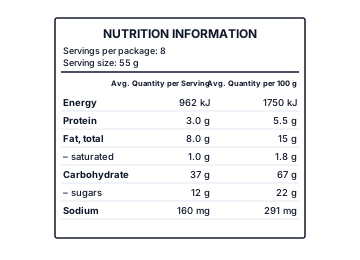
The prescribed format
Section S12—2 of the Code sets the layout: the heading NUTRITION INFORMATION, then "Servings per package" and "Serving size", then rows for Energy, Protein, Fat total, saturated, Carbohydrate, sugars and Sodium, with a "Quantity per Serving" column and a "Quantity per 100 g" (or 100 mL) column. The panel must make clear that the quantities are averages; the generator does this with "Avg." in both column headings.
How the values are expressed
Section 1.2.8—7(3) limits the average energy content and the nutrient quantities to not more than three significant figures. Where the energy in a serving or in 100 g is below 40 kJ it may be shown as "LESS THAN 40 kJ"; protein, fat, carbohydrate, sugars and fibre below 1 g as "LESS THAN 1 g"; and sodium below 5 mg as "LESS THAN 5 mg".
Percentage daily intake
A panel may add the percentage daily intake per serving (section 1.2.8—8). If it does, the percentages must use the Code's reference values — 8 700 kJ energy, 50 g protein, 70 g fat, 24 g saturated fatty acids, 310 g carbohydrate, 90 g sugars, 2 300 mg sodium and 30 g dietary fibre where declared — and the panel must carry the statement "Percentage daily intakes are based on an average adult diet of 8 700 kJ" or its shorter permitted form.