

Surfacing and Testing Your Assumptions
A practical walkthrough: find the assumptions behind a decision, rank them, test the risky ones, and keep them honest over time.
1. What counts as an assumption
An assumption is anything your plan needs to be true but that you have not yet confirmed. "Customers will renew," "we can hire the team in time," and "the supplier can scale" are all assumptions. Most plans rest on far more of them than people realize.
The dangerous ones are usually the quiet, load-bearing assumptions nobody thought to question — the beliefs held so firmly they never get said out loud. When one of those turns out to be wrong, it tends to arrive as an avoidable surprise: late, and expensive. Writing assumptions down is the first step to dealing with them deliberately.
2. Surface the ones you haven't said out loud
You can't manage an assumption you haven't named. These quick prompts, drawn from established practice, help pull hidden assumptions into the open:
- Key Assumptions Check — list the working assumptions your judgment rests on, then ask of each: how confident am I, and what would happen if it were wrong?
- Leap of faith — name the one or two beliefs the whole plan depends on. If these are false, nothing else matters.
- Common areas — walk through customers, demand, cost, timing, people, and technology, asking what you're assuming about each.
- Pre-mortem — imagine the plan failed badly, then explain why. Each reason for failure usually hides an assumption.
- Stakeholders — pick a person or group affected by the decision and ask what you're assuming about how they'll react.
3. Map them by importance and evidence
Once you have a list, plot each assumption on two axes: how important it is (how much your decision depends on it) and how much evidence you actually have for it. That turns a long, intimidating list into a clear picture of where your real risk sits.
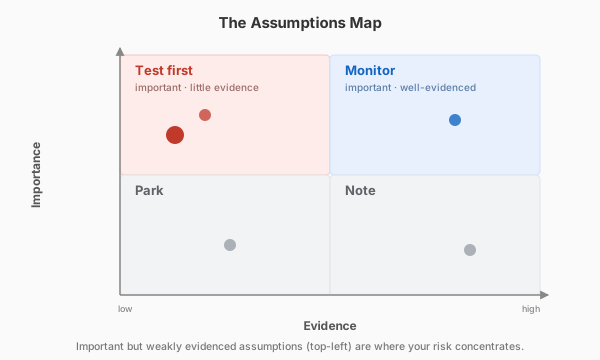
Rate evidence honestly. A strong opinion is not evidence; a single anecdote is weak evidence. Most early assumptions belong on the low-evidence side, and that's perfectly normal — it just tells you where to look next.
4. Decide what to test first
Each assumption lands in one of four zones, and the zone tells you what to do next.
Test first — important, little evidence
This is where your real risk lives. These are the leap-of-faith assumptions your plan depends on yet you're mostly taking on faith. Design a test before you commit — testing one of these early, while it's still cheap to be wrong, beats polishing things you're already sure about.
Monitor — important, well-evidenced
Load-bearing but currently supported. You don't need to test these now, but set a signpost so you notice if the evidence changes.
Park and Note — low importance
Assumptions that wouldn't change much if they were wrong. Record them and move on; don't spend scarce testing effort here.
5. Run a quick test, and set a signpost
To test an assumption, design the smallest experiment that would give you real evidence, decide in advance what result would count as pass or fail, run it, and record what you learned. A pre-sale, a landing page, a few customer interviews, or a quick technical trial are all valid tests. The aim is to replace a guess with evidence before you commit — not to build the whole thing first.
Some important assumptions can't be fully tested up front. For those, set a signpost: an observable early-warning sign that the assumption is starting to break — a metric crossing a line, a customer behavior, a regulatory change. A signpost tells you when to re-examine the decision, so a shift in reality doesn't catch you by surprise later.
6. Track your assumptions over time
Assumptions aren't a one-time exercise. As you gather evidence, move each one along its status — from untested, to testing, to validated, invalidated, or monitoring — so the map always reflects what you actually know.
Revisit the map regularly. Evidence changes, and an assumption that was safe last quarter can quietly become risky. Keeping every assumption in one place — including the ones surfaced in your other decision tools — means nothing important slips through the cracks.
Ready to map your assumptions?
Open the Assumptions Map and surface, prioritize, test, and track the assumptions behind your next decision.
Open Assumptions Map