

Complete Guide to HVAC Duct Sizing
Everything you need to know about sizing ducts for optimal airflow, efficiency, and comfort
Introduction to Duct Sizing
Proper duct sizing is fundamental to any HVAC (Heating, Ventilation, and Air Conditioning) system. Undersized ducts restrict airflow, causing comfort problems and equipment strain. Oversized ducts waste material and installation costs while reducing air velocity below optimal levels.
Why Proper Sizing Matters
- Comfort: Properly sized ducts ensure even temperature distribution throughout the building
- Energy Efficiency: Optimal sizing minimizes pressure drop, reducing fan energy consumption
- Noise Control: Keeping velocity within guidelines prevents excessive air noise
The Three Key Factors
Duct sizing involves balancing three interrelated factors:
- Airflow (CFM): The volume of air that must pass through the duct
- Friction Rate: Pressure loss per unit length of duct
- Velocity: How fast the air moves through the duct
Understanding CFM (Airflow)
CFM (Cubic Feet per Minute) is the standard measure of airflow in HVAC systems. Understanding how to determine required CFM is the first step in duct sizing.
What CFM Means
CFM measures the volume of air flowing past a point each minute. It indicates how much conditioned air is being delivered to (or removed from) a space.
How to Determine Required CFM
Required CFM is typically determined by a load calculation (Manual J for residential) that considers room size, insulation, windows, occupancy, and equipment. Here are typical ranges:
| Room Type | Typical CFM Range |
|---|---|
| Bedroom | 100-150 CFM |
| Living Room | 200-400 CFM |
| Kitchen | 150-250 CFM |
| Bathroom | 50-100 CFM |
| Home Office | 100-200 CFM |
Round vs Rectangular Ducts
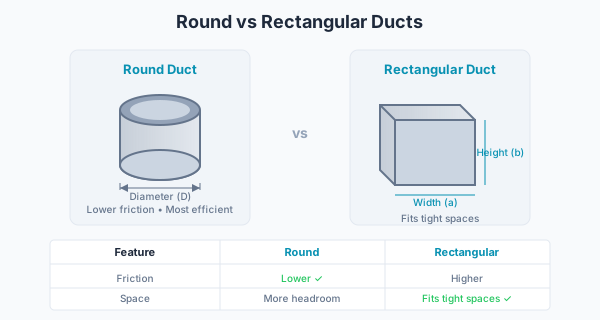
Both round and rectangular ducts have their place in HVAC systems. Understanding when to use each helps optimize your design.
Round Duct Advantages
- Lower friction loss per unit area - more efficient airflow
- Easier to seal - better air tightness
- Lower material cost for same airflow capacity
- Quieter operation at equivalent velocities
Rectangular Duct Advantages
- Fits in tight spaces with limited height clearance
- Easier to fabricate custom fittings on-site
- Can handle very large airflows when height is limited
Equivalent Diameter
To compare rectangular ducts to round ducts, we use the equivalent diameter - the diameter of a round duct with the same friction and airflow characteristics. The Huebscher equation calculates this:
Where a and b are the rectangular duct dimensions in inches, and De is the equivalent diameter in inches.
Friction Rate Selection
Friction rate is the pressure drop per 100 feet of duct, measured in inches of water gauge (in.wg). Lower friction rates require larger ducts but reduce operating costs.
| Application Type | Low | Typical | High |
|---|---|---|---|
| Residential | 0.06 in.wg/100ft | 0.08 in.wg/100ft | 0.10 in.wg/100ft |
| Commercial | 0.08 in.wg/100ft | 0.10 in.wg/100ft | 0.15 in.wg/100ft |
| Industrial | 0.10 in.wg/100ft | 0.15 in.wg/100ft | 0.25 in.wg/100ft |
Velocity Guidelines
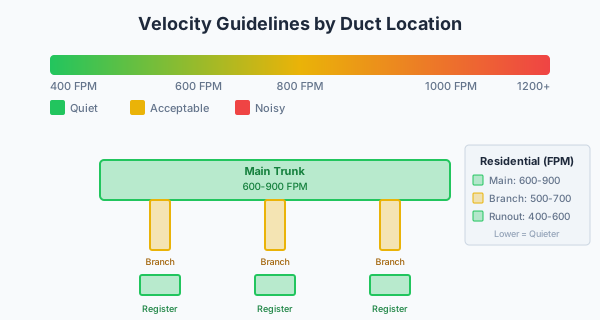
Air velocity through ducts must be kept within recommended limits. Too fast causes noise; too slow can cause poor distribution.
Why Velocity Matters
- Too High: Causes excessive noise, especially at grilles and registers. Most complaints about noisy HVAC systems trace back to high duct velocities.
- Too Low: May cause stratification (hot/cold layers), poor mixing, and increased dust settling in ducts.
Recommended Velocities — FPM (Feet per Minute)
| Duct Location | Residential | Commercial |
|---|---|---|
| Main Trunk | 600-900 FPM | 1000-1300 FPM |
| Branch | 500-700 FPM | 800-1040 FPM |
| Runout / Register | 400-600 FPM | 600-800 FPM |
Values from ASHRAE Handbook and ACCA Manual D. Return air velocities are typically 10-15% lower than supply.
Duct Materials
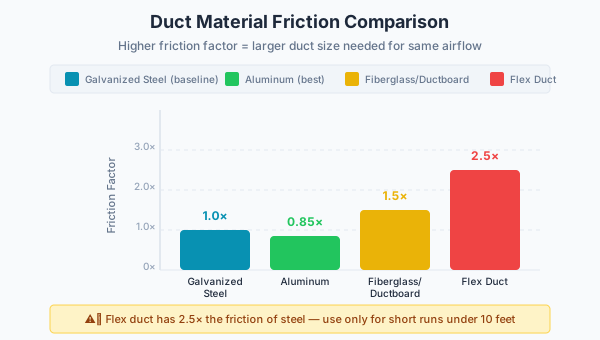
Duct material affects friction, cost, and installation requirements. Each material has trade-offs to consider.
Galvanized Steel
The industry standard. Durable, low friction, easy to seal. Best for main trunks and permanent installations. Typical roughness factor: 1.0 (baseline).
Aluminum
Lighter than steel, corrosion resistant. Good for exposed installations and marine environments. Smoother interior reduces friction by ~15%. Roughness factor: 0.85.
Fiberglass / Ductboard
Pre-insulated with built-in thermal and acoustic properties. Good for exposed ducts where insulation would be needed anyway. Rougher interior increases friction by ~50%. Roughness factor: 1.5.
Flex Duct
Easy to install and route around obstacles. Best for short runouts to registers. Very rough interior increases friction by ~150%. Roughness factor: 2.5. Keep runs short and fully extended.
Sizing Formulas
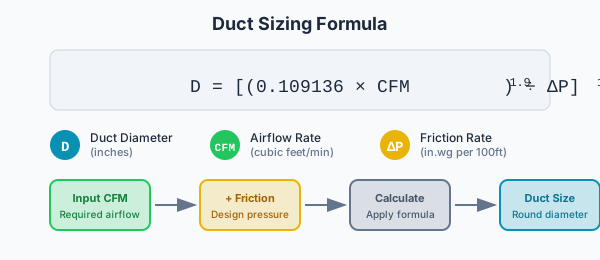
Understanding the math behind duct sizing helps verify calculations and troubleshoot issues.
Round Duct Diameter
The diameter is calculated from CFM and friction rate using the Darcy-Weisbach equation adapted for HVAC:
Velocity Calculation
Area Calculations
Common Mistakes to Avoid
Learn from these frequent duct sizing mistakes:
-
Undersizing to save money
Smaller ducts cost less upfront but cause higher operating costs, noise complaints, and comfort problems. The total cost of undersized ducts is usually higher over the system's lifetime.
-
Ignoring velocity limits
A correctly sized duct can still be noisy if velocity exceeds guidelines. Always check velocity, especially for ducts near occupied spaces.
-
Wrong material selection
Using flex duct for long runs or main trunks dramatically increases friction and reduces airflow. Match material to application.
-
Not accounting for aspect ratio
Rectangular ducts with extreme aspect ratios (>4:1) have poor airflow characteristics. ASHRAE recommends limiting aspect ratio to 4:1 or less.
Sources
Ready to Size Your Ducts?
Use our free duct calculator to size your ducts using industry-standard formulas.
Open Calculator