

Complete Guide to GPA Calculation
Understand GPA, convert grades between international systems, and learn what makes a strong academic record.
1. What is GPA?
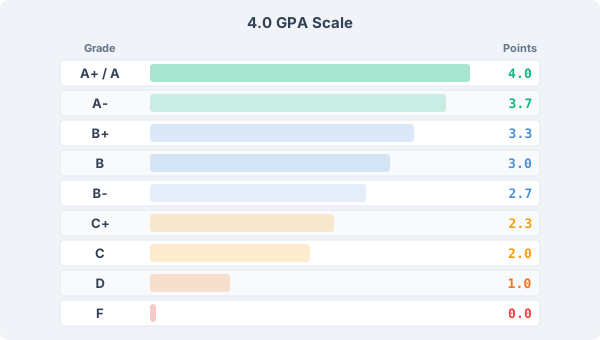
GPA stands for Grade Point Average — a standardized numerical summary of your academic performance. Originating in the US higher education system, it converts letter grades (A through F) into a number on a 4.0 scale and weights them by the credit hours of each course.
The formula is straightforward: multiply each course's grade points by its credit hours, sum the results, and divide by total credit hours. This weighted approach means that a grade in a 4-credit course counts four times as much as a grade in a 1-credit course.
The GPA system is now used or recognized worldwide, though many countries maintain their own native grading scales. International students often need to convert their local grades to GPA equivalents when applying to US or UK universities, graduate programs, or multinational employers.
2. How to Use the Calculator
Start by selecting your country's grading system from the dropdown menu. The calculator supports 10 systems: US 4.0 (A-F), Dutch 1-10, German 1-5, UK degree classification, ECTS (European Credits), Indian CGPA, Greek, Italian, French, and Spanish scales.
Next, enter each course with its grade and credit hours (or ECTS points). You can add as many courses as needed — there is no limit. The calculator updates your GPA in real time as you type.
For international systems, grades are automatically converted to the US 4.0 GPA equivalent. For example, a Dutch 8 converts to 3.7, and a German 1.3 converts to 4.0. You can share your calculation by copying the URL, which encodes all your course data.
3. Dutch Grade Conversion (1-10 to GPA)
The Dutch grading system uses a scale from 1 to 10, where 10 is the highest and 5.5 is the minimum passing grade. In practice, grades of 9 and above are exceptionally rare in the Netherlands — most students graduate with averages between 6.5 and 7.5.
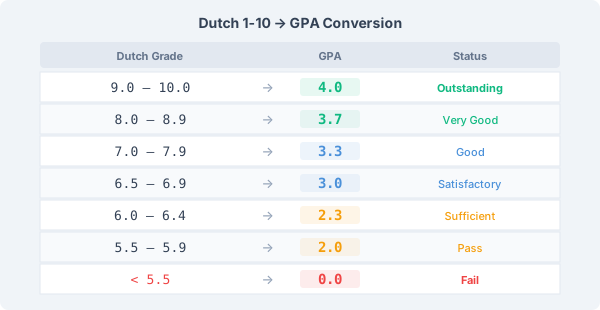
Here is the conversion table used by this calculator, based on NUFFIC guidelines:
Dutch 9.0-10.0 = GPA 4.0 (Outstanding) Dutch 8.0-8.9 = GPA 3.7 (Very Good) Dutch 7.0-7.9 = GPA 3.3 (Good) Dutch 6.5-6.9 = GPA 3.0 (Satisfactory) Dutch 6.0-6.4 = GPA 2.3 (Sufficient) Dutch 5.5-5.9 = GPA 2.0 (Pass) Below 5.5 = GPA 0.0 (Fail)
This means a typical Dutch student averaging 7.0 has roughly a 3.3 GPA — which is considered "Good" on the American scale and meets the threshold for most graduate programs.
4. What is a Good GPA?
What counts as a "good" GPA depends on the context — the institution, the field, and the goal.
3.7-4.0 (Excellent): Qualifies for Dean's List, Latin honors (summa cum laude requires 3.9+), and the most selective graduate programs including top medical, law, and MBA schools.
3.0-3.5 (Good): Meets the minimum for most master's programs and many competitive internships. This is a solid range that keeps most academic and career doors open.
2.5-3.0 (Average): Satisfies minimum graduation requirements at most universities but may limit options for graduate school, honors societies, and selective employers.
Below 2.0 (At Risk): Most institutions consider this academic probation territory. Students in this range should seek academic advising immediately.
For international students, remember that grading cultures differ. A Dutch 7.0 (GPA 3.3) or a German 2.0 (GPA 3.0) may look modest in US terms but represents strong performance within their home systems.
5. International Grading Systems Compared
This calculator supports 10 grading systems, each with its own scale and cultural context:
US 4.0 (A-F): The baseline scale. A = 4.0 down to F = 0.0, with plus/minus modifiers.
Dutch 1-10: Passing grade is 5.5. Scores above 9 are rare. Most students average 6.5-7.5.
German 1-5: Inverted scale — 1.0 is the best, 5.0 is a fail. A German 1.0 = GPA 4.0.
UK Classification: First Class (70%+), Upper Second/2:1 (60-69%), Lower Second/2:2 (50-59%), Third (40-49%).
ECTS (A-F): European standard — A is "Excellent" (top 10%), B is "Very Good" (next 25%).
Indian CGPA (1-10): 10-point scale common in Indian universities.
Greek (0-10): Passing grade is 5.0. Grades above 8.5 are "Excellent" (Arista).
Italian (0-30): University scale where 18 is the minimum pass and 30 e lode is perfect.
French (0-20): Passing is 10. Scores above 16 are exceptional and very rare.
Spanish (0-10): Passing at 5.0. "Sobresaliente" (Outstanding) requires 9.0+.
Sources
Ready to Calculate Your GPA?
Enter your courses, select your grading system, and get your GPA instantly. All calculations are performed locally in your browser.
Open GPA Calculator