Telecom Tones Explained
Understanding the call-progress tones you hear on phone lines
What Are Call-Progress Tones?
Call-progress tones are the sounds a telephone network plays to tell you what is happening with your call. Unlike DTMF tones (which you generate by pressing keys), call-progress tones are generated by the network itself.
In North America, these tones follow the Precise Tone Plan — a set of standardized frequencies and timing patterns established in the 1960s alongside the first electronic switching systems.
The Four Standard Tones
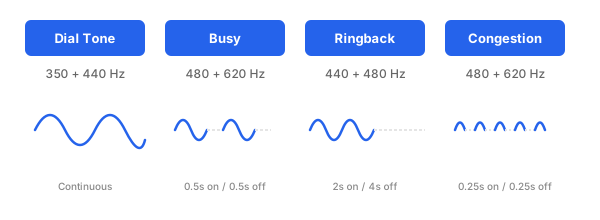
Dial Tone (350 + 440 Hz, continuous): The steady hum you hear when you pick up the phone, indicating the line is ready for dialing.
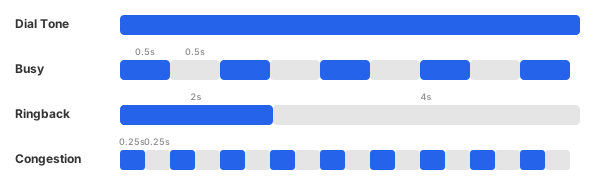
Busy Signal (480 + 620 Hz, 0.5 s on / 0.5 s off): A pulsing tone indicating the number you called is already in use.
Ringback (440 + 480 Hz, 2 s on / 4 s off): The tone you hear while the other phone is ringing. It does not match the actual ring at the other end.
Congestion (480 + 620 Hz, 0.25 s on / 0.25 s off): Also called "fast busy," this rapid pulsing indicates the network cannot complete your call — all circuits are busy.
Cadence Patterns
Busy and congestion tones use the same frequencies (480 + 620 Hz) but are distinguished by their timing. The busy signal pulses at half-second intervals, while congestion pulses twice as fast at quarter-second intervals. This faster cadence is why congestion is often called "fast busy."
Ringback has the longest cycle: 2 seconds of tone followed by 4 seconds of silence, matching the typical ring pattern at the called party's end.